
Introduction
We report results more than ever, but we learn too slowly how to improve them and spot what the limits of results-based measurement and/or management have been for decades; that is, since new public management in the early 1990’s and its predecessor, Drucker’s management by objectives, thirty years before. [1]
“Management by results - like driving a car by looking in a rear view mirror.” W. Edwards Deming (1942) [2]
This article explains a response to that unease. Building on my first post, this blog introduces an approach I call Thoughtful Monitoring TM.
Not a new layer. Not a MEL framework. Not a method. Not a better dashboard. Not another taxonomy of indicators.
It is rigorously relational. The approach helps create space for, and brings together, the thoughtfulness of managers, field teams, and client beneficiaries so they can talk to each other in real ways, learn lessons, and take action. Despite the resurgence of participatory approaches that privilege those who are intended to benefit from the support, the continuing silence of frontline staff stifles innovation and adaptation. [3]
Thoughtful Monitoring also learns from history. It builds on the pioneering work of Dennis Rondinelli in the late 1980s: Decentralised decision-making, continuous adjustment based on feedback from implementation experience, and the creation of systems that learn and adapt while the intervention is underway, with monitoring information actively shaping decisions, not merely reporting them.[4]
The five features of Thoughtful Monitoring TM
It focuses on decisions and users by starting with the needs of managers, implementers and client beneficiaries - Its task is not “identify information needs” by retro-fitting these into some framework. It’s to surface decision uncertainties in time and in context;
It integrates monitoring into management and delivery by embedding it within existing functions, processes, responsibilities, and workflows, avoiding standalone activities that drift from and work in parallel to operational, financial and decision-making realities;
It adapts to context and uncertainty by accepting how “success always starts with failure” [5] using rapid feedback loops to spot problems and opportunities early, helping to navigate unknowns, enabling timely changes in the change process and reducing implementation risk and wasted resources;
It promotes learning and practical insight by testing assumptions, and drawing on frontline experience and indigenous knowledge systems through storytelling to inform ongoing improvement; and
It strengthens accountability and relevance by balancing donor requirements with accountability and responsiveness to the people programmes serve, valuing lived experience, and aligning with priorities on results, learning, and risk management without relying on overly prescriptive systems.
It begins from a simple proposition: monitoring should help these groups of people decide, not merely report on what has already happened; and with a discipline that goes beyond responses to questions such as: what information do you need and/or what questions do you need answers to?
“A performance measurement system needs to tell you whether the decisions you’re making now are going to help you in the coming months.” Likierman (2009) [6]
And it insists on something equally important - this does not require more complexity or sophistication. On the contrary, it requires less. Keep it simple. Resist the reflex to add complexity. The problem with most monitoring systems is not just too many indicators; it is too many indicators that are not explicitly tied to decisions, thresholds, or consequences.
Better monitoring is not more elaborate monitoring or just adding a method or two. It is more focused, more selective, and more honest about what is actually needed to act.
Its starting point
Most monitoring systems begin with a familiar question: What should we measure, typically shown among an array of indicators, in some framework.
Thoughtful Monitoring TM begins somewhere else entirely: with decisions.
Who needs to decide what - today?
What do they not yet understand well enough to decide with confidence?
What information would actually change their mind or their action?
This is not a methodological refinement. It is a reversal of logic.
Monitoring is then designed backwards, from real decisions, in real time. Information is no longer collected because it reveals itself in some framework, but because it is useful. Usefulness is defined entirely by whether it improves a decision.
This approach does not add layers. It removes them. It strips systems down until only what is decision-relevant remains.
It converges around a small set of practical convictions
Decisions come first. Monitoring exists to inform action, not to justify it after the fact;
Uncertainty is normal. It is not a design flaw, but the starting condition of any meaningful decision;
Knowledge is distributed. Client beneficiaries, frontline teams, and managers each hold partial truths; none is sufficient alone;
Timeliness matters more than volume. Information that arrives too late is often indistinguishable from no information at all;
Usefulness is the only real standard. If data does not change understanding or action, it is noise; and
Simplicity is a discipline. Improvement does not come from accumulating indicators or frameworks, but from the disciplined refusal of unnecessary complexity or sophistication.
Thoughtful Monitoring TM is not adopted as a system….
……It is delivered through three fundable components that can be contracted together or separately aiding monitoring itself to evolve and adapt to the context.
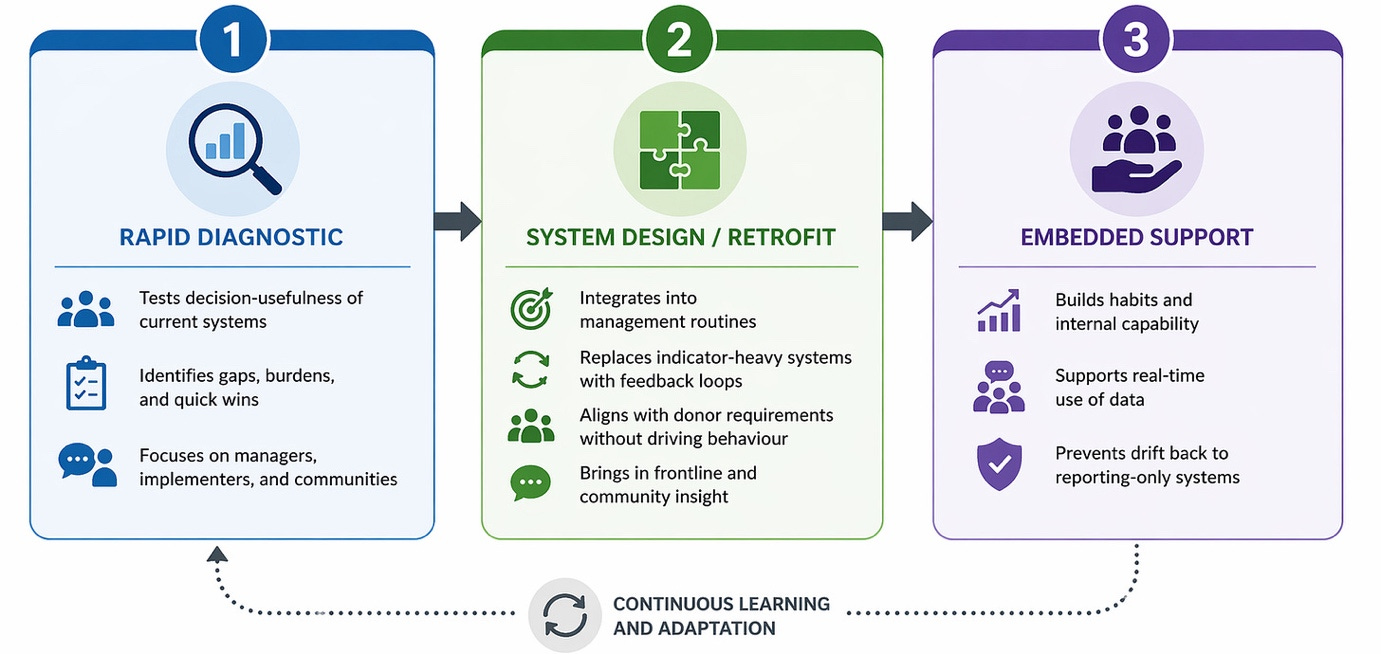
The Diagnostic is not a review of indicators or a refresh of frameworks, but rather a bespoke interview guide and structured process to identify why monitoring fails to inform decisions among different groups of decision-makers, and how to fix it.
System design involves co-designing (or refining) monitoring so that it is embedded in core management routines, job descriptions and delivery processes, enabling communities and frontline staff to share and act on what they see and experience rather than wait for management approval at every turn.
Embedded support provides accompaniment for managers and teams so Thoughtful Monitoring TM becomes part of how we manage, and what we do, not a contrived, external add-on.
This flexible à la carte design allows users to adopt its five features selectively rather than as a rigid, all-or-nothing framework.
What Changes in Practice
When monitoring is built in this way, the roles of those involved begin to change.
Client beneficiaries are no longer treated as data points, but as active participants in shaping understanding, reflecting on what support they need, why it matters, and how it should be delivered;
Managers are required to confront their real uncertainties: what they do not understand, and where decisions are being made on assumptions that have never been properly tested; and
Field teams are no longer reduced to data collectors but are recognised as essential sources of lived experience, and are therefore able to surface what is working, what is not, and why. [7]
This is not monitoring as extraction. This is more than data. It is monitoring as part of the exchange that delivers interventions and the process that stimulates change - the inspiration for Developmental Evaluation. (Pers Comm Michel Quinn Patton.) Let me explain.
Rather than rejecting results, Thoughtful Monitoring TM makes them more achievable by learning about and improving how programmes and organisations respond during implementation, ensuring people receive timely, relevant, and effective support.
For example, within a few weeks, you can see not just that uptake is low in District X or Ministry Y , but which implementers are struggling, what assumptions are failing, and whether the problem is demand, delivery capacity, or policy interpretation.
Thoughtful Monitoring TM is not adopted as a system: it builds on what is there already; and is delivered through the three fundable components that can be contracted together or separately aiding monitoring itself to evolve and adapt to the context.
The Diagnostic reviews current monitoring and management practices, with a focus on the five features of Thoughtful Monitoring TM. System design involves co-designing (or refining) monitoring so that it is embedded in core management routines, job descriptions and delivery processes, enabling communities and frontline staff to share and act on what they see and experience. Embedded support provides accompaniment for managers and teams so Thoughtful Monitoring TM becomes part of how we manage, and what we do, not an external add-on.
And because it is anchored in decision points rather than reporting requirements, it becomes faster, more relevant, and more adaptive:
Data arrives in time to matter;
Frontline knowledge becomes actionable rather than anecdotal; and
Programmes adjust before failure becomes inevitable.
Monitoring shifts:
Retrospective → Real-time;
Extractive → Embedded; and
Indicator-driven → Decision-driven.
It moves from describing change after the fact to shaping it while it is still possible.
An Invitation
Thoughtful Monitoring TM is not a framework to implement or a system to install. It is a way of starting differently:
Start with decisions that matter;
Ask what is not understood;
Identify what would genuinely change action; and
Design for that, and only that.
From there, the practice builds through use: through conversation, adjustment, and shared learning among those closest to the work.
This is an invitation to work differently - to treat monitoring not as an administrative requirement or retrospective justification, but as a living tool for navigating uncertainty and improving decisions as they are made.
“Cross the river by feeling for stones” - Attributed to Deng Xiaoping
Thoughtful Monitoring TM shifts monitoring from a reporting obligation into a strategic asset that strengthens effectiveness, accountability, and real-world responsiveness.
I’m working with a select group of organisations to put Thoughtful Monitoring into practice - diagnosing what’s not working, redesigning for real decisions, and supporting teams on the ground and in the office.
If you’re interested, let’s talk.
References
[5] Harford, T. (2011) Adapt. Why success always starts with failure. Little, Brown Book Group
Agreed Julian! Indeed
I’ve been promoting Goal Attainment Scaling (Kiresuk & Sherman,1968) for over 40 years years as a lead indicator which requires thinking about the futurity of goals and decisions:
https://personalconcerns.substack.com/p/governance-and-strategic-evaluation?utm_campaign=post&utm_medium=web&triedRedirect=true